
The Logotherapist as Witness: The Rubik’s Cube and the Untangling of the Knot
By: John Piedrahita, LMHC, LMFT
In the course of logotherapeutic dialogue, I often find myself reflecting on the nature of what unfolds between therapist and client—the sacred process of meaning discovery, unveiling, and self-realization. It is a process that ultimately belongs to the individual; it is their task to embark upon, their inner calling to fulfill. And yet, as logotherapists, we are privileged to serve as guides, witnesses, and participants in this redemptive unfolding. Through our interventions—our carefully chosen questions, our attuned silences, our presence—we help the client turn the prism of perception just slightly, until a new color / facet of understanding emerges.
This dynamic can be seen as a metaphorical process: the untangling of a knot or the solving of a Rubik’s cube. Both are deeply instructive images, for they convey not only the challenge and patience involved but also the technical precision, the faith, and the rhythm of persistence that meaning-oriented work requires.
The Rubik’s Cube as a Metaphor for Logotherapy
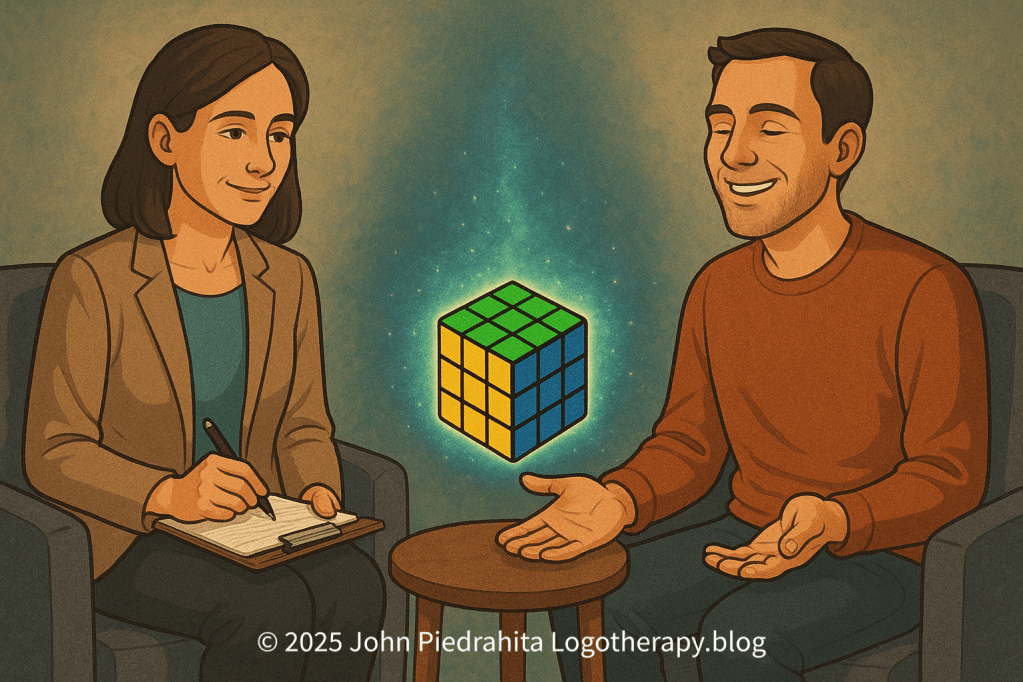
The Rubik’s cube is universally familiar, and therein lies its pedagogical power. Each side of the cube—scrambled in colors and order—represents the fragmented dimensions of a person’s life: emotional, existential, relational, and spiritual. The process of turning and rotating the cube parallels the logotherapist’s use of Socratic dialogue and noetic reflection. With each “turn” of inquiry, each reframing, the individual’s perspective shifts slightly, bringing into alignment previously dissonant parts of the self.
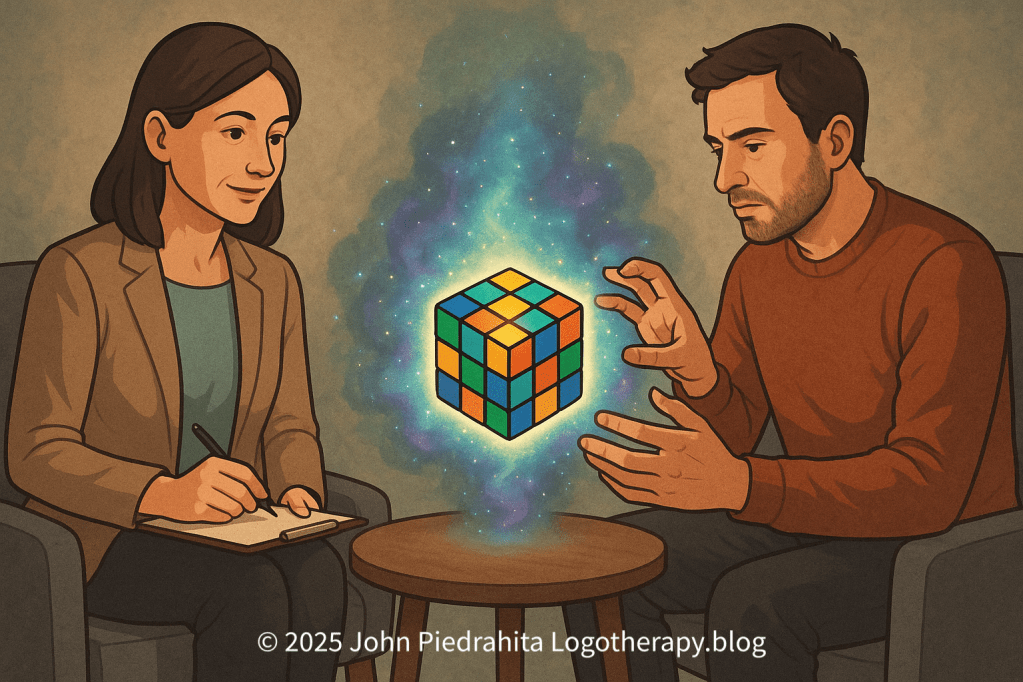
At first, these turns may appear repetitive, even redundant. Yet, as in therapy, repetition is not meaningless—it is deliberate. It refines awareness, deepens insight, and allows what was unconscious or chaotic to find its proper orientation. Often, it is through these repeated movements that one square, one side, finally begins to make sense, and meaning re-emerges from confusion. The cube’s eventual alignment becomes a metaphor for noetic congruence—the harmony of the person’s inner world with their higher purpose and self-transcendent values.
The Hair Knot: A Metaphor of Phases and Fluidity
The metaphor of the hair knot offers a complementary image. Unlike the mechanical logic of the Rubik’s cube, the knot suggests organic, emotional, and nonlinear movement. It conveys both fragility and entanglement—the tenderness of the human condition.
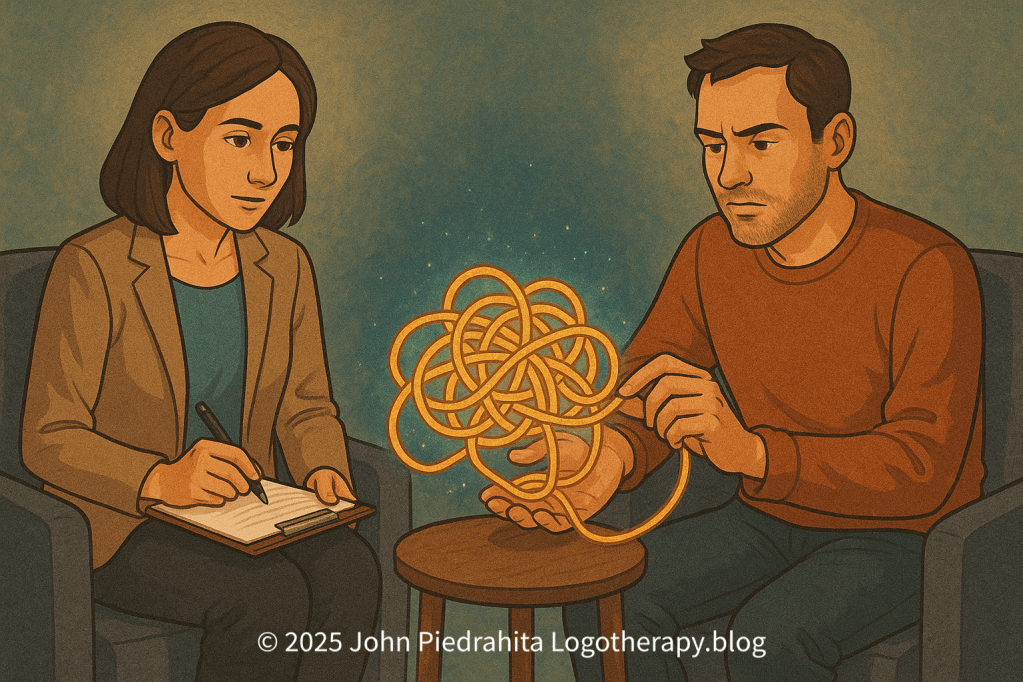
The process of untangling a knot unfolds in key phases, much like the therapeutic journey.
In the first phase, there is the feeling of powerlessness: “I don’t know what to do.” This is the existential confrontation—the moment when one faces the anxiety of confusion and the limits of one’s understanding.
The second phase brings curiosity and brainstorming—the courage to explore, to ask, to begin probing into the entanglement itself. This is where logotherapeutic questioning serves as a lifeline, allowing the client to look at the knot from multiple angles, without fear or avoidance.
The third phase is the incremental untangling: slow progress through patience, insight, and applied will. This is the heart of therapy, where cognitive, attitudinal, and noetic clarity begin to interweave.
At times, impasses appear—moments of resistance, frustration, or confusion. But eventually, an unlocking occurs—a sudden understanding, a reorientation of perception that allows the entire system to loosen.
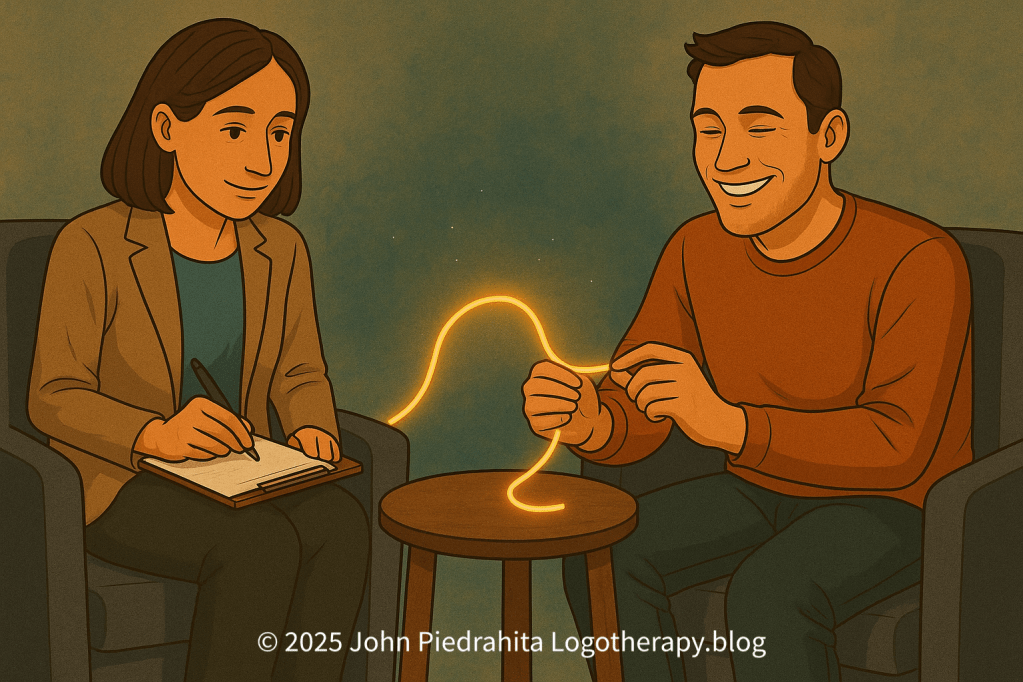
From here, the process becomes fluid, intuitive, effortless. The client no longer struggles against their inner knots but works with them, guided by a newfound sense of coherence. They have attuned themselves to their own noetic truth. The neurosis dissolves, replaced by meaning, acceptance, and self-realization.
Bearing Witness to the Unveiling
To sit with someone in this process—to witness the turning of the cube or the untangling of the knot—is profoundly humbling. It is redemptive work, not only for the client but for the therapist as well. In these moments, one is reminded that meaning cannot be imposed—it must be discovered. We cannot force enlightenment; we can only witness the unveiling.
The logotherapist, then, is not the solver of the puzzle nor the one who untangles the knot. Rather, we are the ones who hold space—who remain present and attuned to the process as it unfolds. Through empathy, technical precision, and noetic faith, we bear witness to the client’s emergence into freedom. And in that witnessing, we too are changed.
In the end, the work of Logotherapy is not about control or correction—it is about unveiling, alignment, and presence. It is about the luminous moment when what was once entangled becomes clear; when what was once chaotic finds its rhythm; when the client, sitting before us, finally smiles—not because the Rubik’s cube has been solved or the knot fully undone, but because they have found meaning in the process itself.
In Logos,
(c)2025 John Piedrahita
 Logotherapy Research Group South Florida
Leave a comment